B2B Sales & Aftersales
The future of industrial B2B: From order entry to intelligent order processing
5 mins read

B2B organizations have invested heavily in CRMs, ERPs, and portals. The problem is that customers never agreed to use them properly.
There is a version of B2B operations that works smoothly in theory. Customers submit structured requests through the right channels. Data flows cleanly into the right systems. Sales and service teams spend their time on things that actually require human judgment. Nobody is re-entering the same information three times or deciphering what a customer meant by "the usual order but bigger."
Then there is how it actually works. Requests arrive as forwarded email threads with no subject line, WhatsApp messages, voicemails, PDFs with handwritten annotations. Each one needs to be read, interpreted, matched to the right products or services, and keyed into a system that had no idea the customer was even thinking about placing an order.
This is not a people problem. The teams handling these requests are perfectly capable. It is a structural mismatch between how customers communicate and how businesses are set up to receive that communication.
The tax on every interaction
Manual interpretation at the front end of every order or service request adds a cost that most businesses have simply accepted as normal. Someone reads the message. Someone figures out what was meant. Someone enters it into the system. Someone else catches the error from the first someone misreading a part number. By the time the request is processed, a meaningful chunk of a skilled person's day is gone, and the customer is still waiting for confirmation.
This overhead is invisible on any single transaction. Spread across the full volume of daily interactions in a mid-size B2B operation, it is substantial, both in direct cost and in the delay it introduces at the moment a customer is trying to get something done.
"The goal for every customer is always the same: get something done quickly. The internal complexity of the business is not their problem to navigate."
What customers actually experience
From a customer's perspective, the friction is not the system itself. It is the effort. Logging into a portal, finding the right form, remembering which fields are required, following up when nothing happens. Each of these is a small tax on the relationship, and customers are less willing to pay it than they used to be.
Consumer technology has conditioned people to expect that asking a question and getting an answer are essentially the same action. That expectation does not disappear when someone sits down to place a B2B order. If anything, business buyers are more sensitive to friction because their time is constrained and the consequences of delays are real.
Read more about why conversational AI is replacing the customer portal here!
The opportunity cost that rarely gets measured
When sales and service teams are occupied with interpretation and data entry, they are not doing relationship work. They are not noticing that a request is missing something the customer will need. They are not having the consultative conversation that increases order value or prevents a problem downstream. Operational load does not just slow things down; it crowds out the work that actually builds accounts.
What changes when AI can understand a request directly
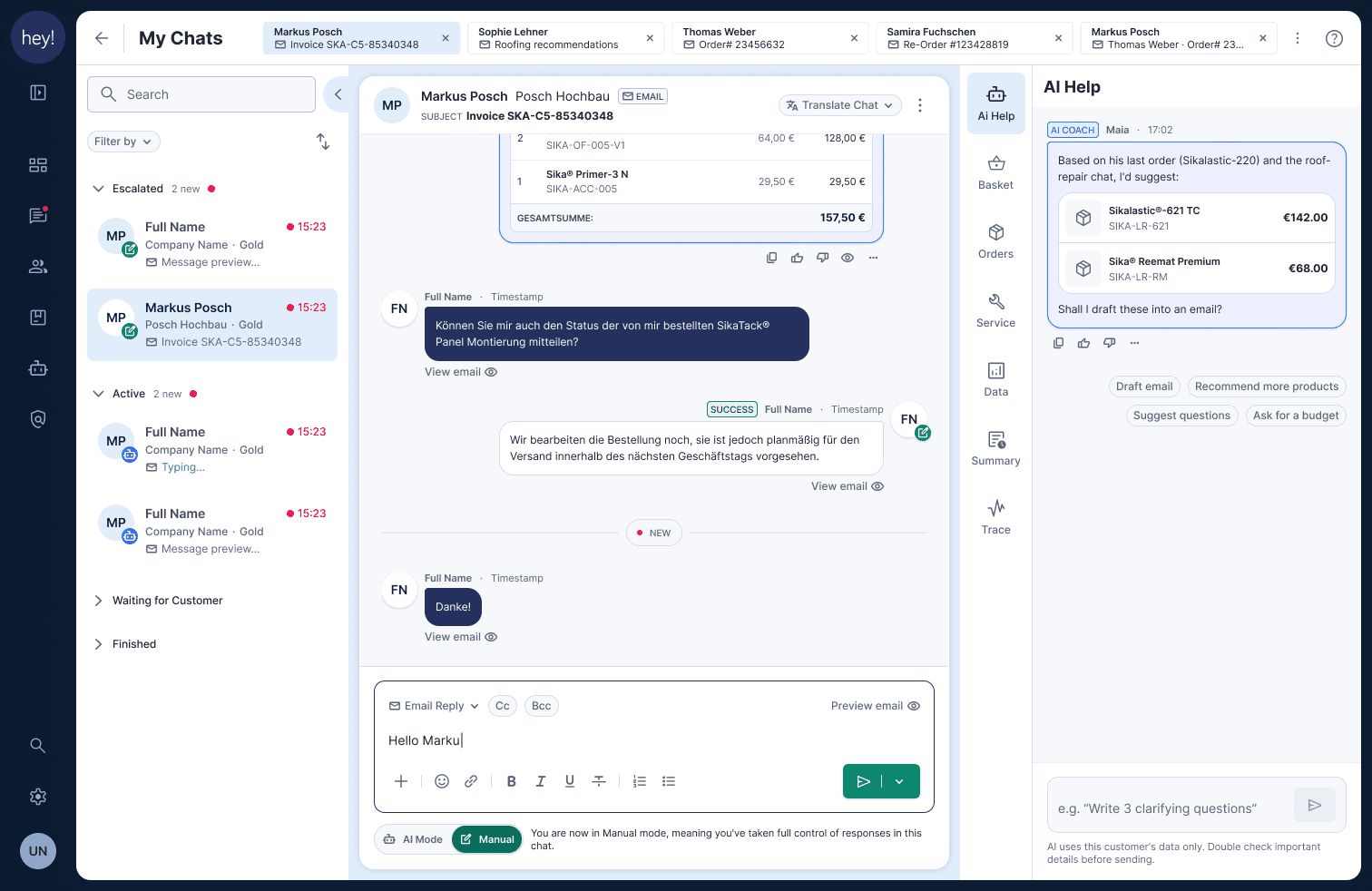
The shift that matters is not chat interfaces or automated replies. It is what happens when a system can take an unstructured, informal, incomplete request and reliably extract what it means: which customer, which products, what quantities, what context from previous orders. Without a human having to bridge the gap between how the customer communicated and what the ERP needs to process it.
Clear requests get handled automatically. Ambiguous ones get flagged for a human with the relevant context already surfaced. The team stops functioning as a translation layer and starts functioning as the judgment layer it was always supposed to be.
The operational effects are significant: faster response times, fewer errors, lower cost per transaction, and a process that scales with order volume instead of against it. But the commercial effect is just as important. Teams that are not buried in processing have capacity to do the work that actually moves customer relationships forward.
Interactions as information
There is a longer-term case here that often gets overlooked. Every customer interaction contains signal: what they need, how frequently, where patterns are shifting, which requests keep coming up informally but never make it into a formal order. Most of that signal is currently lost because it arrives in unstructured form and gets processed just enough to fulfill the immediate request before disappearing.
When interactions are captured and understood consistently, they become something more useful than a transaction log. They tell you which customers are changing their behavior before it shows up in the numbers. They surface product gaps and service issues earlier. They give account teams something concrete to work with in customer conversations rather than a general sense that things are going fine.
The future of B2B sales and aftersales is not more systems. Most organizations already have more systems than they know what to do with. It is removing the friction between what customers say and what businesses can act on. That is a narrower problem than it sounds, and a more solvable one than most teams realize.