B2B Sales & Aftersales
Why conversational AI is replacing the customer portal
5 mins read

B2B companies spent years building customer portals on a simple premise: give people one place to do everything. That premise was wrong.
Here is the uncomfortable truth about most B2B customer portals: customers do not like using them. They log in reluctantly, navigate by memory, and frequently give up and call a sales rep instead which defeats the entire purpose.
This is not a UX problem. It is not a feature gap. It is a category error. Portals assume customers want a system. What customers actually want is an answer.
The friction nobody talks about
Think about what happens when a customer wants to know where their order is. They remember (or reset) a password. They find the right section. They cross-reference a reference number. Three minutes later, maybe they have what they need.
Now think about what they actually wanted: a two-second answer to a single question.
Every extra step is friction. And friction, in aggregate, erodes the relationship. Customers start routing around the portal, calling sales teams, emailing account managers, finding workarounds. The self-service tool designed to reduce support burden ends up increasing it.
"Customers are not thinking about where information lives inside a system. They are thinking about resolving a need."
Consumer tech has set expectations B2B cannot ignore
People do not experience B2B and B2C technology in separate mental compartments. The same buyer who tracks their personal orders through a WhatsApp message or resolves a billing issue through a chat window will arrive at your portal on Monday morning carrying those same expectations.
Ask a question in plain language. Get a direct answer. Move on.
Most B2B portals fail this test badly. They require users to learn an interface rather than simply use it. A trade-off that made sense in 2010 and makes very little sense now.
What conversational AI actually changes
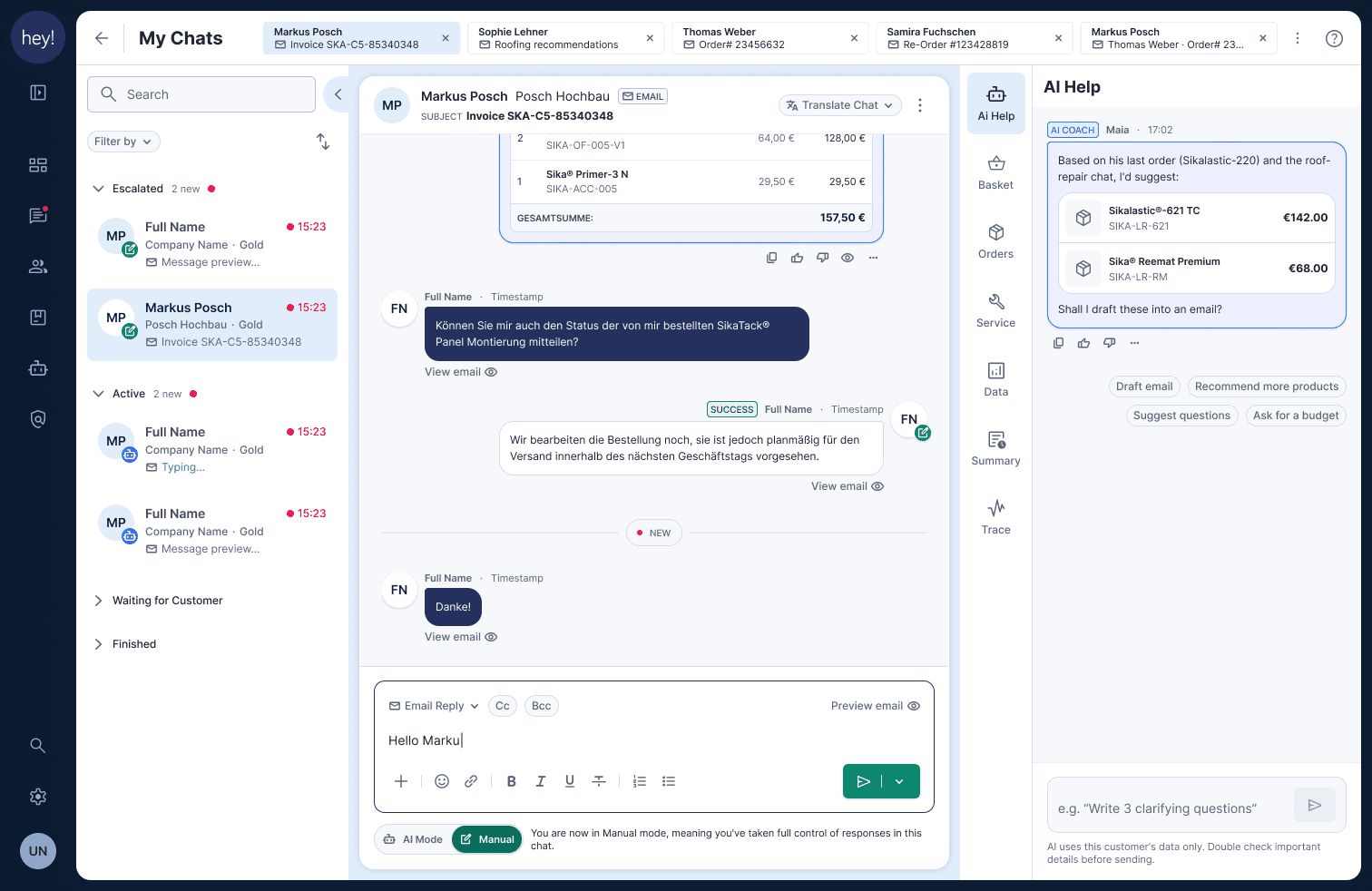
The shift is not cosmetic. Replacing a portal with a chat interface is not the point. The deeper change is architectural: moving from destination-based engagement to distributed engagement.
A portal requires customers to come to it. Conversational AI goes to them: inside email threads, inside the messaging apps they already use, inside the tools they spend their day in. The interface becomes invisible. The interaction becomes natural.
What this looks like in practice
A buyer on Teams asks "Can I reorder the same batch as last month?" and gets a confirmation in thirty seconds. No login. No navigation. No searching for an order number from six weeks ago. Just an answer and a prompt to confirm.
That same logic applies across the full customer lifecycle. A sales inquiry becomes a quote. A quote becomes an order. An order generates a support question or a reorder. In a portal model, each of these is a separate workflow in a separate section. In a conversational model, they are moments in a continuous thread.
How this affects sales and aftersales
One of the more underappreciated benefits is how this collapses the artificial wall between sales and aftersales. Portals tend to treat them as different functions, different pages, different logins, different teams. Conversations do not work that way. Context accumulates. A customer asking a post-delivery question is still in a relationship with your sales org, and the system should reflect that.
In sales, conversational AI can qualify and route leads, surface pricing and product information without a rep having to intervene, and guide customers through complex configurations in real time. In aftersales, it handles tracking, troubleshooting, documentation, and reordering - the high-volume, low-complexity work that ties up support teams disproportionately.
Where portals fit from here
This is not an argument for abandoning every portal. They will persist as backend systems, the databases and records that need to exist. But they will stop being the thing customers interact with directly.
The front end of the B2B customer relationship will be conversational. That shift is already underway. The companies building toward it now are quietly making themselves much easier to do business with and in a market where differentiation is genuinely hard, easier to do business with turns out to matter quite a lot.