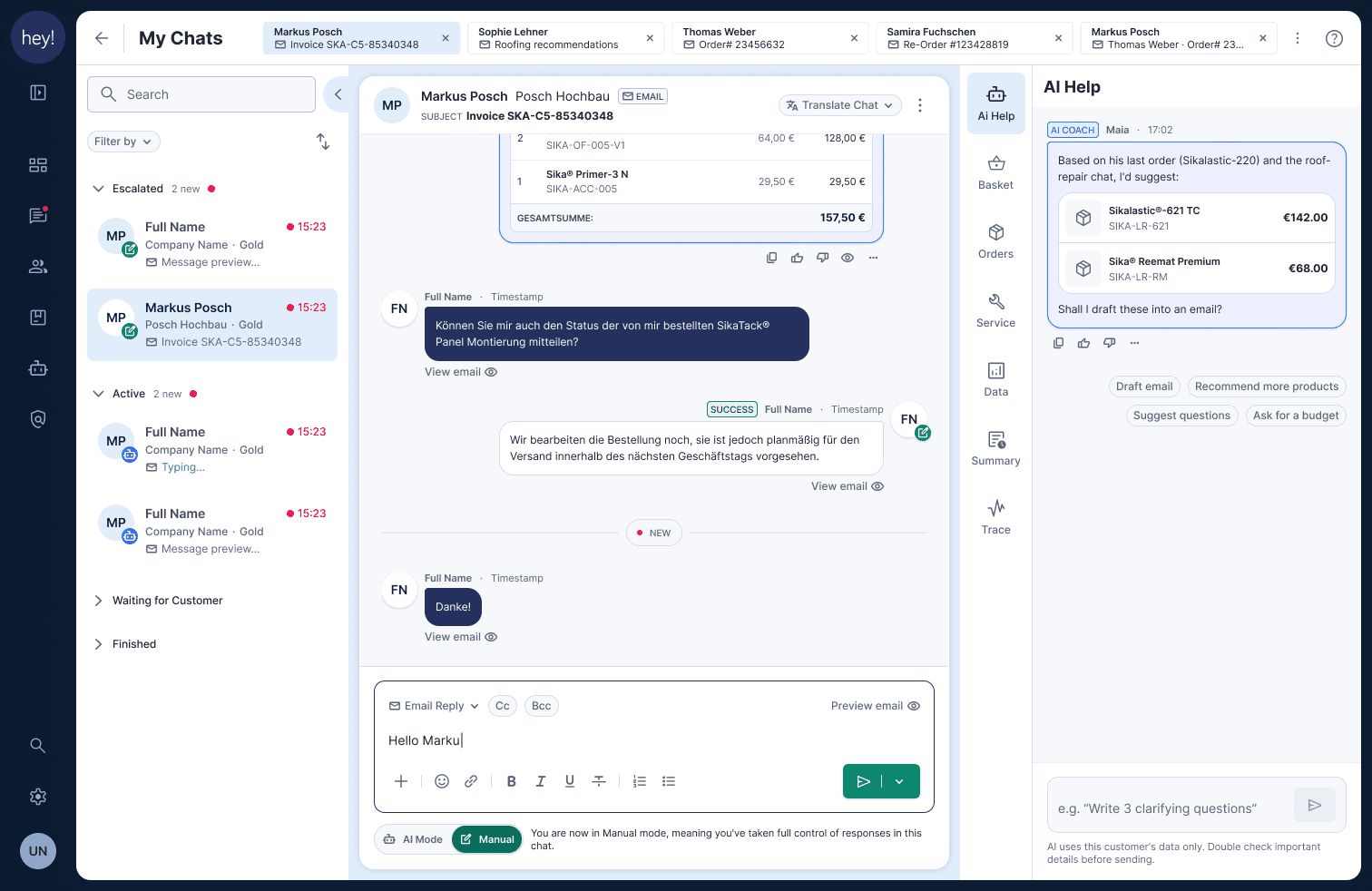
AI Framework
Heyrise AI is not a generic AI platform.
It is an AI infrastructure layer designed for operational business processes — built around control, predictability, adaptability, and sovereign data ownership.
Its architecture is specifically designed for enterprise environments where compliance, operational reliability, and infrastructure control are business-critical requirements.
Book a demo
HEYRISE AI APPROACH
AI Infrastructure for Operational Enterprises
Most AI solutions today are delivered as isolated assistants or black-box applications. Heyrise AI takes a fundamentally different approach. The platform treats artificial intelligence as operational infrastructure — a controllable intelligence layer that integrates into existing enterprise workflows, governance structures, and decision systems. The result is an AI platform that is not only powerful, but operationally controllable, enterprise-ready, and designed for long-term scalability.
The architectural differentiation of Heyrise AI is based on six core principles:
Human-Led AI
AI learns from experts, not vice versa.
Multi-Model Architecture
Freedom from single-model dependency.
Multi-Agent Systems
Specialized agents for operational tasks.
Steering instead of Fine-Tuning
Faster adaptation without retraining.
Fine-Grained Policy Control
Precise governance and compliance.
Data Souvereignity
Full on-premise ownership and control.
HEYRISE AI APPROACH
AI as Controllable Infrastructure
Human-Led AI Instead of Black-Box Automation
AI Should Operationalize Expertise — Not Replace It
Traditional AI relies heavily on static model training. Heyrise AI continuously learns from real business interactions, operational knowledge, and expert behavior.
Benefits:
✓ Business-aligned intelligence
✓ Continuous adaptation
✓ Predictable outcomes
✓ Human oversight remains central
Multi-Model Architecture Instead of Single-LLM Dependency
While many AI providers build their entire stack around a single large language model, Heyrise AI follows a multi-model orchestration approach.
Depending on the operational context, task complexity, security requirements, or performance needs, different AI models can be coordinated dynamically in parallel
This includes specialized models for:
semantic analysis
retrieval
reasoning
communication
process orchestration
knowledge extraction
This architecture creates significant long-term advantages:
reduced vendor dependency
improved fault tolerance
flexible scalability
task-specific model optimization
future-proof technological adaptability

Lukas Hubl
Lead AI & Data
Multi-Agent Systems for Operational AI
Heyrise AI is not built around a single “intelligent assistant.” Instead, it operates through specialized AI agents with clearly defined operational responsibilities.
This multi-agent architecture allows complex enterprise processes to be decomposed into modular intelligence layers such as:
analysis
validation
communication
policy monitoring
knowledge synchronization
decision support
The result is a significantly more robust, transparent, and controllable system architecture compared to other AI platforms.
For enterprise environments, this modularity is essential:
AI evolves from an experimental productivity tool into reliable operational infrastructure.
Steering Instead of Traditional Fine-Tuning
One of the key technological differentiators of Heyrise AI lies in its approach to adaptability and behavioral control. Most enterprise AI systems rely on fine-tuning, retraining models with company-specific data in order to alter behavior. Heyrise AI follows a different architectural philosophy: Steering instead of retraining.
Recent advances in steering-based AI adaptation demonstrate that model behavior can be significantly influenced through lightweight contextual intervention layers without modifying the underlying foundation model weights.
Building on this paradigm, Heyrise AI treats adaptability as a controllable orchestration problem rather than a retraining problem.
While effective in certain scenarios, fine-tuning is often:
computationally expensive
slow to iterate
difficult to interpret
tightly coupled to specific model versions
The Heyrise approach provides substantial enterprise advantages:
significantly faster adaptability
lower computational overhead
greater transparency
improved controllability
easier maintainability
continuous optimization without retraining cycles


Markus Zwirzitz
Co-Founder & CTO
Fine-Grained Policy Control
The platform integrates years of operational communication and sales expertise into a granular rule-based framework that governs not only what the AI is allowed to do but how it behaves.
This includes control over:
communication styles
escalation logic
compliance requirements
role-based behavior
decision boundaries
industry-specific regulations
company-specific operational nuances
As a result, organizations do not receive a generic AI solution, but an intelligence infrastructure layer that adapts precisely to existing organizational structures and governance requirements.
This level of controllability is especially critical in regulated industries and enterprise-scale operational environments.
100% On-Premise AI
Full Infrastructure & Data Sovereignty
One of the most important differentiators of Heyrise AI is its fully sovereign deployment architecture.
Heyrise AI is not merely “privacy-focused” at the application layer.
The complete AI stack — including orchestration systems, models, inference infrastructure, and policy layers — can operate fully on-premise within the customer’s own environment.
Organizations therefore retain full ownership and operational control over:
AI models
inference infrastructure
enterprise data
communication flows
process orchestration
policy systems
security layers
without dependence on external cloud providers or third-party AI platforms.
Unlike many AI vendors that route orchestration, embeddings, or inference through external APIs, Heyrise AI enables enterprises to operate the entire intelligence layer inside their own controlled infrastructure.
This eliminates critical enterprise concerns such as:
external data exposure
uncontrolled model interactions
vendor lock-in
cross-border data transfer risks
third-party infrastructure dependencies
opaque cloud processing pipelines
For organizations operating under strict regulatory, compliance, or security requirements, this is not simply a deployment preference — it is often a prerequisite for enterprise-scale AI adoption.
The architectural philosophy behind Heyrise AI is therefore straightforward:
100% AI
100% Infrastructure Control
100% Data Sovereignty


FH-Prof. DI Dr. Marc Kurz
Research Center Hagenberg