The communication problem hiding inside your commercial operations
5 mins read

Businesses have spent decades optimizing systems for structured data. Yet the majority of customer communication remains completely unstructured.
If you mapped out every touchpoint in your commercial operation, the systems would look fairly coherent. CRM tracks the relationship. ERP handles orders and inventory. A service platform manages aftersales. On paper, information flows from one to the next.
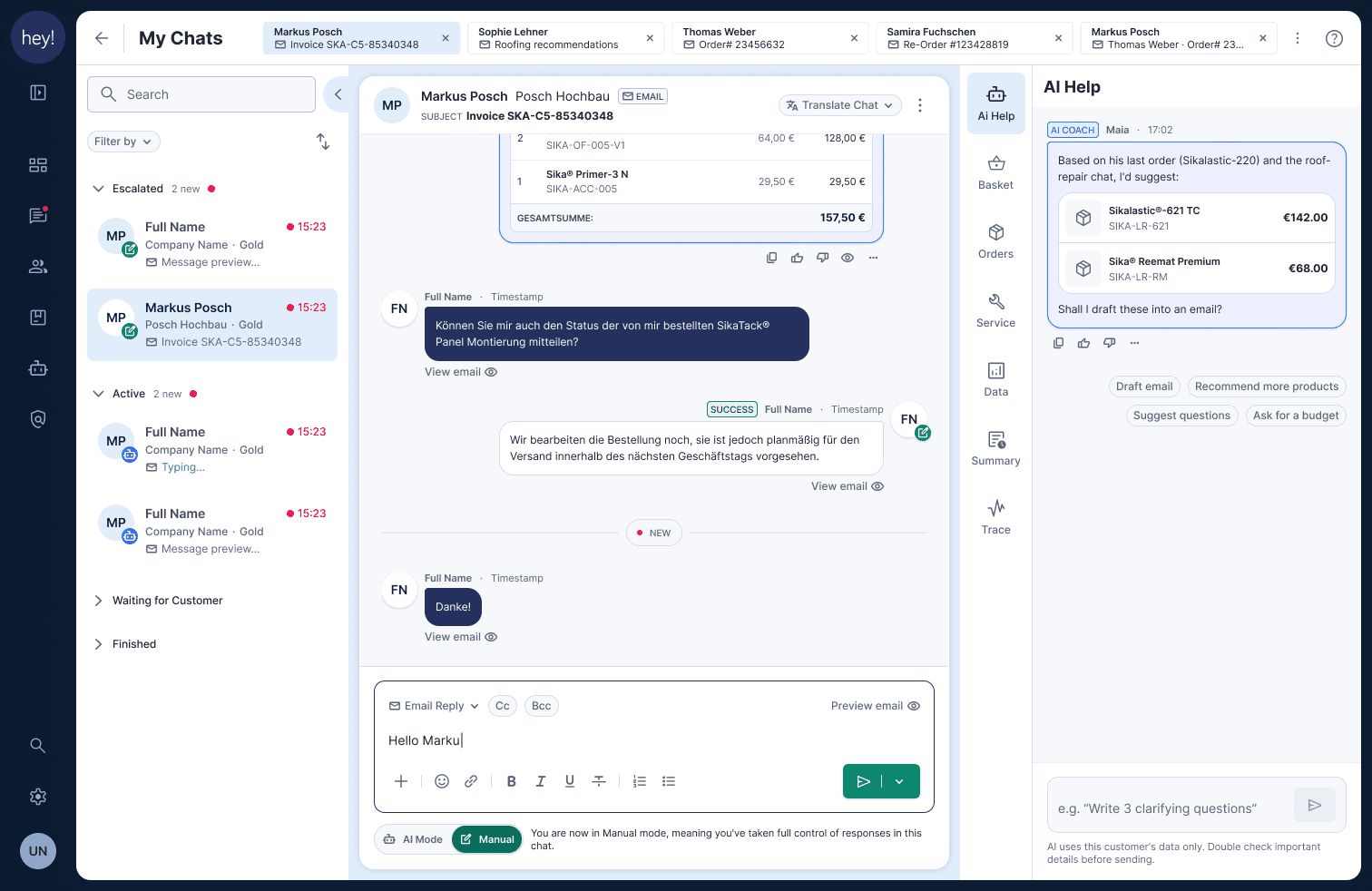
Then a customer sends a WhatsApp message to their sales contact saying the delivery from last week was short two units and they need it sorted before Thursday, also can someone resend the invoice from Q1, and by the way they want to discuss pricing on the renewal coming up next month.
That message contains at least three distinct business actions. It will probably get handled, eventually, by a person reading it and figuring out what to do. Some of it will make it into the relevant systems. Some of it will not. And the customer will have no visibility into any of it until something either happens or does not.
This is not an edge case. It is representative of how a significant volume of B2B customer communication actually arrives.
Why systems were never built for this
Enterprise software is built around structured inputs. A form has fields. An EDI transaction has a schema. A portal submission follows a defined format. These systems are extraordinarily good at processing information once it has been shaped correctly. The problem is the shaping.
Getting from a natural customer communication to a structured system input requires interpretation. Someone has to read the message, understand what is being asked, identify the relevant account and order references, decide which system or team each element belongs to, and then enter it. For a single message this takes a few minutes. Across the full daily volume of a commercial operation, it represents a substantial and largely invisible overhead.
"The bottleneck in most B2B operations is not processing capacity. It is the translation layer between how customers communicate and what internal systems need."
What makes customer communication hard to automate
The reason this problem has persisted is that human language is genuinely difficult to handle programmatically. Customers do not communicate in standard formats. They use shorthand developed over years of working with the same rep. They reference previous conversations without providing context. They bundle multiple requests into a single message. They express urgency in ways that are obvious to a person and invisible to a rules-based system.
Earlier attempts at automating this, keyword routing, basic chatbots, template matching, tended to work well on the simplest requests and fail on anything more complex, which is precisely where the cost of failure is highest. A misrouted urgent complaint or a missed order detail is not a minor inconvenience; it is a customer experience failure with measurable commercial consequences.
The inputs your teams are already handling
In most B2B commercial operations, customer communication arrives as forwarded email chains with no clear subject, voice notes and transcribed calls, informal messages from long-standing contacts who skip formalities entirely, documents with handwritten annotations, and requests that assume shared context from conversations that happened months ago. The common thread is that none of it was designed with your systems in mind.
What has changed
The capability that makes this tractable now is the ability to understand language in context, not just match patterns. Modern AI can read a message, infer the intent behind it even when it is expressed informally, identify the discrete actions it contains, pull the relevant references from prior interactions, and produce a structured output that can actually flow into downstream systems.
This is not the same as a better chatbot. The distinction matters for how executives should think about it. A chatbot handles known questions with known answers. What is being described here is a system that can process genuinely novel inputs, the kind of idiosyncratic, multi-part, context-dependent communications that make up the bulk of real customer interaction, and turn them into reliable operational actions.
The practical effect is that the translation layer, the human effort currently sitting between customer communication and system input, becomes largely automated for the high-volume, lower-complexity requests that make up the majority of interactions. The people who were doing that translation work do not disappear; they shift to handling the cases that genuinely require judgment, which is where their time was always better spent.
The strategic implication
For leadership, the question this raises is not really about technology. It is about where operational leverage actually sits in the business. Most efficiency initiatives in commercial operations focus on the processes that are already visible and measurable: sales cycle length, order processing time, support ticket resolution. The communication layer that feeds all of those processes tends to go unexamined because it is hard to quantify and spread across too many people and channels to get a clear view of.
The organizations that have looked closely at this tend to find that a meaningful share of their commercial overhead is concentrated in the work of handling unstructured inputs. Fixing that does not just reduce cost. It accelerates everything downstream: faster responses, cleaner data, fewer errors, and a customer experience that does not depend on whether the right person happened to read the right message on the right day.
Most B2B businesses are reasonably well optimized for what happens after a request enters their systems. The gap, for many of them, is in the step before that: reliably understanding what customers are actually asking for, in the form they actually ask it. That turns out to be a solvable problem, and the solution has more downstream impact than most people expect.